
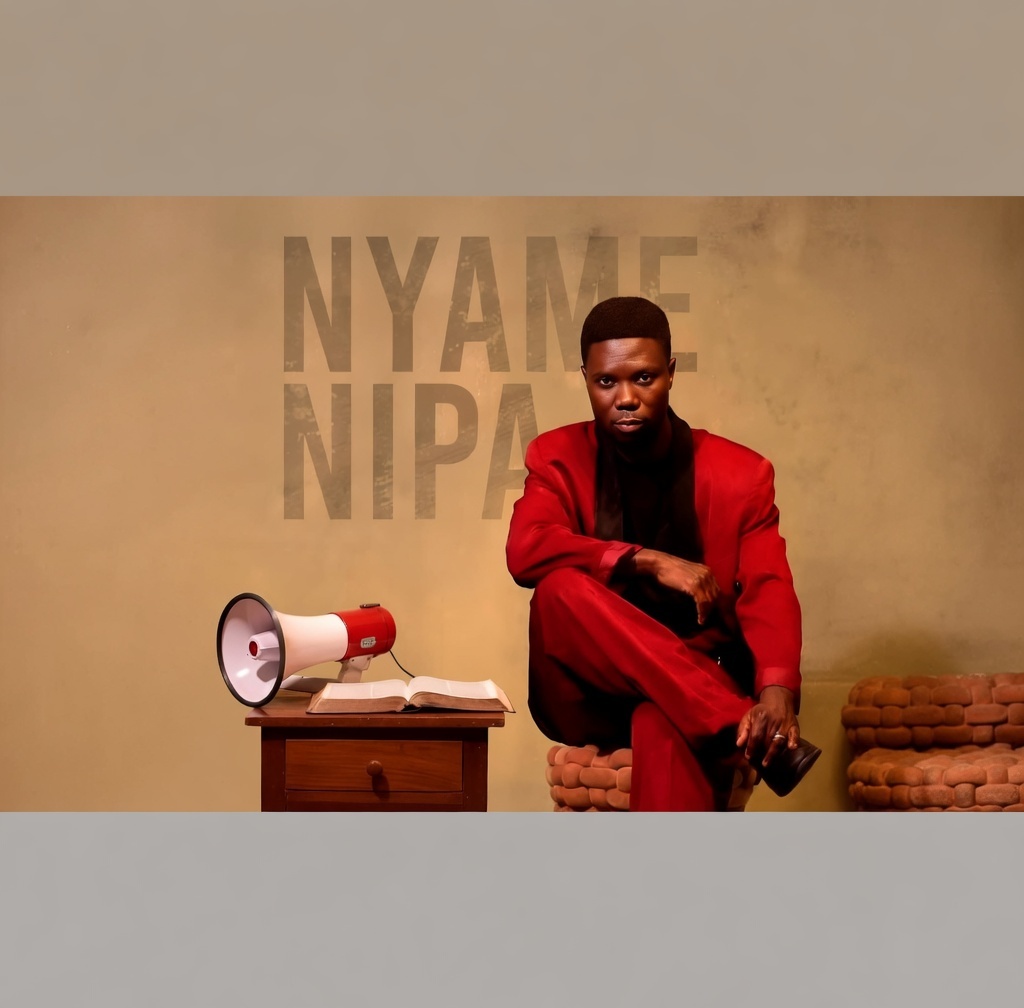
The doctrine of suffering has a prominent place in Christian ministry mainly because central to the Christian faith is a rugged cross. A symbol of death and gloom that has become a source of light and life to humans, the world over, and in all generations. How we go from an instrument of death becoming the greatest transformational, life-giving force ever experienced by man is a spectacle of the power and love of God. Due to this, the Christian’s attitude towards affliction and adversity must differ from that of the world. This idea is the central theme of Nhemy’s new EP, Nyame Nipa, which means Man of God in English. Everything about this project screams faith and hope in God in the face of adversity: from the album title and cover to the lyrics, beat selection, features, and track arrangement. The rapper explores at great length the theme of defiance in the face of adversity. Even at times, you catch a whiff of mockery in his attitude towards the difficulties of life. Highlighting these themes is the focus of this write-up.
On the album cover, you see Nhemy sitting down with legs crossed, donning an oversized red/wine suit with a megaphone and an open Bible resting on a coffee table next to him. Typically, he depicts the appearance of the everyday street preacher/evangelist in Ghana. I must point out these elements of the album, since they run through all the songs in a way that projects the beautiful tapestry that is the availability of God’s grace to his children in their darkest hours.
The album opens with the rapper reading a passage of scripture in Twi. He reads from John 16:31-32, where Jesus informs his disciples that a time would come when they would all be scattered; he would be left alone, but he would not be alone because the Father was with him. This intro track pretty much sets the tone for the entire album. Here we have the ultimate “Man of God” foretelling his time of misery, where his closest associates would abandon him. But before the miserable events took place, he was already encouraging himself and finding solace in the fact that the Father would be with him. This seems to be Jesus’ standard approach to dealing with adversity, and it is worth emulating by all of us. We must endeavour to anchor our faith and hope in the truth that God will never forsake us, even if the whole world did. This is faith.
The Lamentation:
With this background, you would expect the entire project to be synonymous with the book of Lamentations. But that isn’t the case. It is only in the second track of the album, “Farasifo” (Pharisees in English), that we hear the rapper lament about his plight so bitterly. The content of the track reflects the heavy burdens he has been bearing; mostly the comments his listeners and social media followers pass about his ministry. Some have said he probably should quit rap and focus on singing since the current trend in global music culture leans more towards danceable tunes rather than message-heavy rap songs. He laments this situation and goes on to offer some advice to others and encourage himself as well. Rap music and “worship” music should all be done to the glory of God, and if the glory is the aim of the artist, then whatever medium he chooses should be a secondary matter.
We don’t have to pretend to be superhumans who are not affected by difficult situations. It is fine to acknowledge the fact that you are being bombarded by trials. What did the Psalmist say? “Many are the afflictions of the righteous, but the Lord delivers him from them all” – Psalm 34:19. Acknowledging the fact that you are afflicted doesn’t diminish the power of God in any way – especially when you spend a greater part of a 7-track EP basking in the power of God and his grace. This is exactly what Nhemy does for the rest of the album.
The defiance and mockery in the face of adversity:
This is by far the biggest theme the rapper explored on this project. The two terms, “defiance” and “mockery”, put together produce the following concepts: contempt, repugnance, and despisal in the face of adversity. How Nhemy explored this theme reminds me of what Hebrews 12:2 says about Christ, “he endured the cross and despised the shame“. Because of the joy set before him, Christ literally treated the shame he felt on the cross with contempt rather than being overwhelmed by it. In the song “Bullets”, featuring Kobi Newton, Nhemy paints the picture of a man of God going through the valley of the shadow of death, only that he calls it the valley of the bullets. Which is literally the same thing if you picture a war scene where soldiers are marching through a valley yet being bombarded by a confetti of enemy bullets. The chorus goes like this, “code red, rainy days, covered by the blood – that be every day, DANCE THROUGH THE VALLEY OF THE BULLETS/ Mogya no nti, me dodgee”. You would expect soldiers at war to run through the valley of bullets or even duck from the flurry of bullets. But here is a gallant soldier of the LORD, dancing amidst the flurry. That’s defiance and mockery in the face of adversity. In Nhemy’s verse, he says, “If Jesus bore the cross, I’ve got no regrets / I’m still connected to the vine, and he’s got a winepress”. The rapper reminds us here that although we are branches connected to Christ, who is the vine, he has a sophisticated setup that squeezes out new wine from us. Often, this setup or winepress is the day-to-day adversities of the Christian life and ministry as well. Kobi Newton also comes in with an interesting perspective on the topic. He points out the fact that a peaceful, blissful life is not without drama. In all of this, what matters is the believer’s attitude towards the trials they face. He also echoes the theme of defiance when he admonishes believers at the end of his verse to pay little attention to the bullets flying about in the valley of the bullets.
This song ends uniquely. It ends with the sound of a street preacher, singing through a megaphone with the sound of gunshots in the background. The preacher sings the popular Twi hymn, “Yesu ka wo ho” (Jesus is with you in English), which basically says that even if mountains are moved and cast into the sea, do not fear, for Jesus is with you. He sings this for a while, then goes on to proclaim in Twi, “beloved, give your life to Jesus!!” This is to say that, regardless of what the preacher/minister is going through, the gospel should still be proclaimed. In the midst of a flurry of enemy bullets, this street preacher sang a song to remind his listeners of God’s abiding presence, and he also declared an evangelistic message at the end. Epic!
Who would have thought we needed a praise break right in the middle of the album? In the song “Ayeyi” (Praise in English), Nhemy sings praises to God in a unique way while maintaining the symbolism of the entire project. Let me explain. The beat of this song is reminiscent of the tunes played at one of Ghana’s prominent street festivals: the Ankos Masquerade street festival or parade, popularly held on the streets of Takoradi in December every year. At this festival, masquerades suit up and dance to various tunes played by a brass band as they march through the principal streets of Takoradi. Nhemy confirms this when he opens his verse by saying in Fante “Amas, beat no, way3d3 masquerade parade” to wit “Amas, this beat is reminiscent of a masquerade parade“. I might be stretching the metaphor here, but by speaking Fante in this line, he is probably referencing the Ankos Masquerade street festival because Fante is the predominant language spoken in Takoradi. In the song, he also depicts the theme under discussion when he says, “I’ve got company/ Father, Son, and Spirit I’m following/ Noonday arrow, I’m dodging it/ King’s blood, that be my covering”. The third line is an allusion to Psalm 91:5, which admonishes the believer not to fear the arrow that flies by day nor the terror by night. Like in “Bullets”, we see here too that the blood of Jesus is depicted as a covering for the believer when they go through trials and tribulations. The idea of dodging bullets in the song “bullets” is repeated here, only that, in this case, the believer dodges noon day arrows because the blood of Jesus is their covering.
The rapper makes a mockery of the walls of Jericho in the skit that precedes the song “Jericho”. In the skit, we hear him in an informal and jovial tone retell the story of how the walls of Jericho fell. He describes the scene mockingly by saying the walls of Jericho folded like a bedsheet. This is an interesting perspective to have about a formidable impediment, such as the wall of Jericho, and how it fell. Now to the song, “Jericho”, which I have come to believe is the lead single and radio-friendly song on the album. The chorus is written in the similitude of a chant that is probably meant to be loudly sung and proclaimed in unison by a crowd. The chorus goes like, “Jericho, you no go stand/ You go come down now in Jesus’ name”. This is such a bold and defiant declaration to make while facing the impregnable wall of Jericho. In Nhemy’s verse, he said “the bigger the problem, I will be jubilating / me gyina Jericho enim ehim me hanky”, to wit, I stand before Jericho cheerfully waving my handkerchief. Nobody stands before a towering and impregnable wall that they are hoping to break down or penetrate, dancing and gleefully waving their handkerchief. Well, except for the one who is ‘defiantly’ making a mockery of the problem at hand because his God can do all things. Nhemy ends his verse by saying “Yesu din nti y3 te nkwa mu 3hwe nkwan d3”, to wit, “because of the name of Jesus, we are alive and kicking and eating good”. Lol, Amen, Nhemy!
On this song, he featured Dani Lambano, whose verse is a biblical allusion to the story of Abraham and the birth of Isaac. This is evident in this line (and others in his verse), “hope against hope but still I no dey stagger”, which reminds us of what was said about Abraham not staggering in his faith in Romans 4:21. Dani ends his verse with this line “s3 )haw no so sen wiase mpo aa, e go fall”. Which means even if the trials we face are bigger than the earth (or the world), they will fall. Again, this is such a bold and defiant claim in the face of adversity. A problem that is metaphorically bigger than this earth is actually very big. So, to say in confidence that even at that size, the problem will eventually fall, is nothing short of a defiance and a refusal to be intimidated by adversity.
The album ends with the remix of Nhemy’s song “Power dey here” featuring Monte. It is the perfect ending to an album like this that seeks to remind the believer going through trials that God is powerful. In the chorus, he sings, “the resurrection got me feeling so alive / with the power on the inside, I’ve got might / who dey kick against the pricks? This no be fight / I’ve got victory, my Jesus dey alive”. This song highlights the certainty of the power of God at work in the life of a believer. As sure as the sun will rise tomorrow, we should be sure that God’s power is available and working in our lives. The third line also points to the irresistibility of the power of God. You can’t resist it or fight against it. When Nhemy sings, “Who dey kick against the pricks? This no be fight,” it takes us to Saul’s encounter with Jesus on the road to Damascus. This was the exact question Jesus asked him, “‘Saul, Saul, why are you persecuting Me? It is hard for you to kick against the goads (pricks)’”, Acts 26:14. Jesus made this remark to point out the fact that nobody can stand against the power of God and prevail. You can’t resist God in all his power, so better not try. This is what this line in the chorus reminds me of. And it is a perfect ending to a project that seeks to outline the biblical way of dealing with adversity: you read his word, you lament, you defy and despise the adversity, even employing mockery at times, you praise God, some more defiance, then you remind yourself of the power of God through prayer. That is the entire album in one sentence; I believe it is set up to engender faith in the believer despite the many challenges of life.
Seriously, God bless Nhemy and his team. This album is on constant rotation in my house. It is a 12-min EP that has a lot of replay value because of how poignant the message is and how he and his featured artists address the topics with such lyrical dexterity. I honestly wish that every Christian would listen to this project and learn a thing or two about how to face the adversities of life and ministry. Nyame Nipa is such a great body of work, and I love every minute of it.